
Introduction
Makar Sankranti is a festival that announces change. It does not arrive quietly. It brings sunlight, warmth, movement, and celebration into everyday life. Unlike many Indian festivals that depend on the Moon, Makar Sankranti follows the Sun, which gives it a rare sense of stability in the calendar.
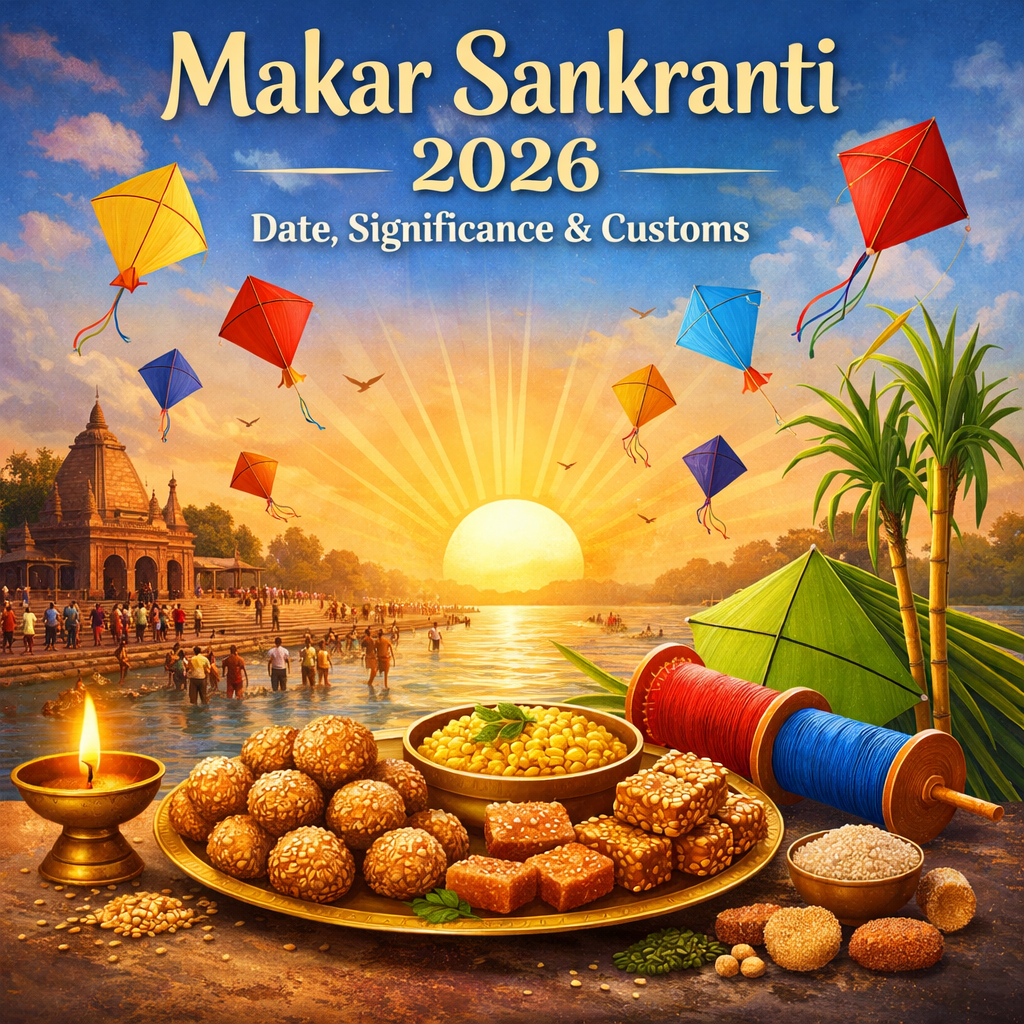
In 2026, people across India will observe Makar Sankranti with prayers, food sharing, donations, and joyful outdoor activities. The festival marks a seasonal turning point as well as a spiritual shift. It reminds people that progress begins when light increases and darkness reduces.
This guide explains Makar Sankranti 2026 in detail its date, meaning, belief system, customs, food habits, and regional practices using simple and original language.
Table of Contents
Makar Sankranti 2026 Date and Calendar Importance
📅 Makar Sankranti in 2026 falls on Wednesday, 14 January.
The festival occurs when the Sun enters the zodiac sign Capricorn, known in Sanskrit as Makar. This astronomical movement is predictable, which is why the festival usually remains on the same date every year.
Because it is tied to the Sun rather than lunar phases, Makar Sankranti stands apart from most Hindu festivals. This solar connection gives it special importance in both religious belief and agricultural life.
What Does Makar Sankranti Represent?
The meaning of Makar Sankranti is closely connected to transition.
- Makar refers to Capricorn
- Sankranti means movement or shift
Together, they describe the moment when the Sun changes direction and begins its northward journey, known as Uttarayan.
In traditional belief, this phase is considered favorable. Days become longer. Nights become shorter. Energy slowly returns to the land. Symbolically, it reflects growth, awareness, and forward movement.
Spiritual Meaning of Makar Sankranti
Makar Sankranti is associated with clarity and discipline.
Sun as a Source of Order
The Sun is seen as a regulator of time, seasons, and life. On this day, people express respect to the Sun for sustaining nature and guiding human activity.
Uttarayan and Positive Direction
In Hindu philosophy, Uttarayan is linked with progress and awakening. Many spiritual traditions consider this period suitable for new beginnings and thoughtful action.
Purification Through Action
Instead of complex rituals, Makar Sankranti focuses on simple acts bathing, giving, praying, and sharing—which makes its spiritual message accessible to everyone.
Ritual Practices Followed on Makar Sankranti
The customs of Makar Sankranti vary by region, but the intention remains the same.
Common practices include:
- Bathing early in the day
- Offering water to the rising Sun
- Visiting temples
- Giving food or clothes to those in need
- Preparing seasonal dishes
The festival encourages calm behavior, respectful speech, and generosity.
Why Charity Is Central to Makar Sankranti
Donation is not treated as obligation on this day. It is considered a voluntary act of balance.
People donate:
- Food grains
- Warm clothing
- Sesame seeds
- Jaggery
- Money
The belief is that what is shared returns in another form, strengthening social harmony.
Regional Forms of Makar Sankranti in India
Though the core idea is shared, Makar Sankranti adapts to local culture.
Gujarat – Uttarayan
Known for large-scale kite flying. Homes turn into celebration spaces. The sky becomes a canvas of movement.
Tamil Nadu – Pongal
A harvest-based celebration lasting several days. Farmers, cattle, and nature are honored through food and prayer.
Punjab – Lohri
Observed with fire rituals, folk music, and dancing. It celebrates the passing of winter’s peak.
Assam – Magh Bihu
Focused on community meals and seasonal gratitude.
These variations show how Makar Sankranti connects local identity with shared belief.
Kite Flying and Its Cultural Meaning
Kite flying is one of the most visible symbols of Makar Sankranti.
It represents:
- Lightness and joy
- Human connection with the sky
- Seasonal outdoor activity
It also encourages people to step outside during winter mornings, which was traditionally linked to physical well-being.
Food Traditions of Makar Sankranti
Food prepared during Makar Sankranti reflects climate and nutrition.
Common items include:
- Sesame sweets
- Jaggery-based snacks
- Rice and lentil dishes
- Pongal and khichdi
Why Sesame and Jaggery Matter
These ingredients are warming, easy to digest, and energy-rich. They suit winter needs and are widely available across regions.
Sharing food on this day strengthens social bonds.
Makar Sankranti 2026 Puja Timing
Puja is usually performed after sunrise when the Sun is visible.
Most families:
- Offer water to the Sun
- Light a lamp
- Recite simple prayers
Exact timings may differ slightly by location, so local calendars are often followed.
Recommended Behavior on Makar Sankranti
Things to Do
- Keep the day simple
- Be respectful and calm
- Help others when possible
- Spend time with family
Things to Avoid
- Heated arguments
- Wasteful behavior
- Excessive indulgence
The festival encourages balance rather than restriction.
Modern Relevance of Makar Sankranti
Even today, Makar Sankranti holds meaning.
It reminds people to:
- Respect natural cycles
- Pause and reset goals
- Value sharing over accumulation
- Recognize seasonal change
In a fast-moving world, the festival acts as a quiet checkpoint.
Conclusion
Makar Sankranti 2026 arrives as a reminder that movement is natural and necessary. As the Sun begins a new directional journey, people are encouraged to reflect, share, and realign their priorities.
Through simple customs, seasonal food, and regional celebrations, Makar Sankranti continues to connect ancient observation with everyday life. It is not only a festival of the Sun, but also of awareness, responsibility, and renewal.
FAQs – Makar Sankranti 2026
Q1. What is the date of Makar Sankranti 2026?
It will be observed on 14 January 2026.
Q2. Why does Makar Sankranti have a fixed date?
Because it depends on the Sun’s position, not lunar phases.
Q3. What does Uttarayan mean?
It refers to the Sun’s northward movement.
Q4. Why is charity important on Makar Sankranti?
It promotes balance, gratitude, and social harmony.
Q5. Is Makar Sankranti a harvest festival?
In many regions, yes. It is closely linked with agricultural cycles.
You can also read our full list of Indian festivals in 2026 to plan your celebrations easily on khabarmanufacturing24x7.com