
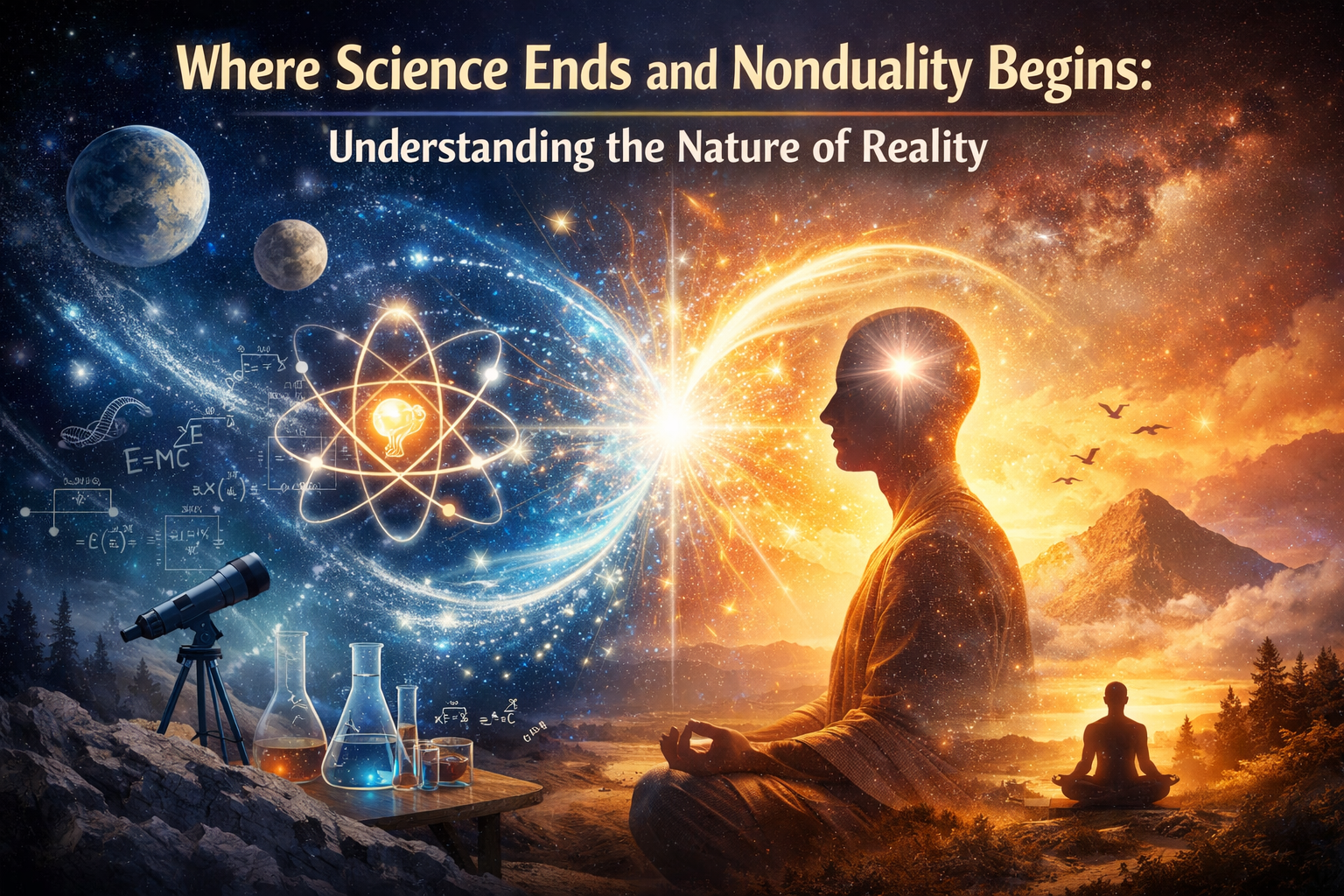
For centuries, science has helped humanity decode the mechanics of the universe. From the movement of planets to the structure of atoms, scientific inquiry has provided reliable models that explain how reality behaves. Yet, despite its remarkable success, science often stops short when asked the deepest question of all: What is reality, and who is experiencing it?
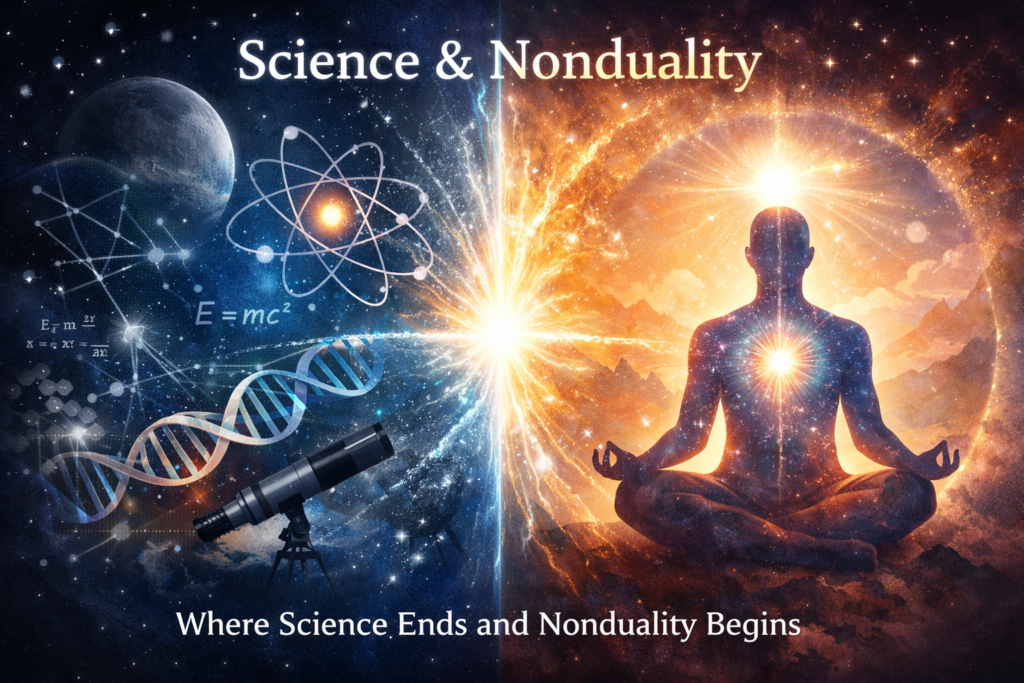
This is where Science and Nonduality intersect—at the edge of explanation, where measurement fades and direct experience begins.
Nonduality does not oppose science. Instead, it explores what lies beyond objective analysis: the nature of awareness itself. This article examines where science reaches its limits and how nondual understanding offers a complementary way to explore existence.
Table of Contents
The Strength and Limits of Science
Science excels at studying the observable world. It relies on measurement, repeatability, and objectivity. Using tools and experiments, science breaks reality into parts, analyzes patterns, and builds predictive models.
However, this strength is also its limitation.
Science depends on a fundamental assumption: there is an observer studying an object. Whether it is a scientist observing a particle or a telescope observing distant galaxies, the observer-object division is always present. Science cannot step outside this framework because its methods require it.
This is why science can explain processes but struggles with experience.
For example:
- Science can map brain activity during thoughts.
- Science can analyze neural responses during meditation.
- Science can describe consciousness correlations.
But science cannot answer why experience exists at all, or what awareness itself is.
The Observer Problem in Modern Science
One of the most intriguing cracks in the scientific worldview appears in quantum physics. At the quantum level, observation itself seems to affect outcomes. Particles behave differently when measured, challenging the idea of a fully independent external reality.
While physicists debate interpretations, the implication is profound: the observer cannot be cleanly separated from what is observed.
This insight quietly echoes a central message of nondual.
Nonduality suggests that the observer and the observed are not fundamentally separate. Instead, both arise within the same field of awareness. Where science treats this as a puzzle, nondual treats it as a starting point.
What Is Nonduality?
Nonduality literally means “not two.” It points to the idea that reality is not divided into subject and object at its deepest level. There is no separate “me” observing a separate “world.” There is only experiencing happening.
Unlike belief systems or religious doctrines, nondual is based on direct inquiry into experience. It asks simple but radical questions:
- What is aware of this thought?
- Where does experience occur?
- Is awareness itself divided?
Nondual does not deny the practical distinctions of daily life. Instead, it reveals that these distinctions are functional, not fundamental.
Where Science and Nonduality Diverge
The key difference between Science and Nonduality lies in method.
Science:
- Studies objects
- Uses third-person observation
- Depends on external measurement
Nonduality:
- Investigates awareness itself
- Uses first-person inquiry
- Relies on direct experience
Science cannot study awareness as it truly is, because awareness is the very condition that allows study to happen. Any attempt to objectify it turns it into something else.
Nondual addresses this gap by shifting attention inward not to analyze, but to notice.
Consciousness: The Unresolved Frontier
Consciousness remains one of science’s greatest unsolved problems. While neuroscience can describe brain activity, it cannot explain how subjective experience arises from matter.
This “hard problem of consciousness” highlights the boundary of scientific explanation.
Nondual approaches consciousness differently. Instead of asking how consciousness emerges, it asks whether consciousness is primary, not produced.
From a nondual perspective:
- Consciousness is not inside the brain.
- The brain appears within consciousness.
- Experience does not belong to an individual—it happens within awareness.
This is not a theory but an experiential insight that can be examined directly.
Why Nonduality Is Not Anti-Science
A common misunderstanding is that nonduality rejects science. In reality, nondual respects science for what it does well.
Science describes how reality behaves.
Nondual reveals what reality is experienced as.
They operate at different levels. Conflict arises only when one is expected to replace the other.
In fact, many scientists, philosophers, and neuroscientists are increasingly open to nondual perspectives because they address questions science cannot currently resolve.
Living the Insight of Science and Nonduality
Understanding Science and Nonduality is not only an intellectual exercise—it has practical implications.
When the sense of separation softens:
- Stress often reduces
- Fear loses intensity
- Compassion arises naturally
- Identity becomes less rigid
Life is still lived normally, but with less resistance. Problems are addressed without the added burden of psychological struggle.
This does not require adopting new beliefs. It requires noticing what is already present.
The Meeting Point: Complementary Truths
Science and nonduality meet at the edge of knowing.
Science says: “This is how the universe works.”
Nonduality says: “This is how the universe is experienced.”
One maps the territory.
The other reveals the ground on which the map appears.
Together, they offer a more complete understanding of reality—one that honors both objective knowledge and subjective truth.
FAQs: Science and Nonduality
1. What is the main difference between Science and Nonduality?
Science studies reality through measurement and observation, while nondual explores reality through direct awareness and experience.
2. Can science ever prove nonduality?
Science may point toward nondual insights, but nondual itself is not something that can be proven—it must be experienced.
3. Is nonduality a religion?
No. Nondual is a perspective or insight into the nature of experience, not a belief system or religious doctrine.
4. Does nonduality reject scientific facts?
Not at all. Nondual accepts scientific explanations while addressing questions science cannot answer.
5. How can someone explore nonduality safely?
Through self-inquiry, mindfulness, or guided teachings focused on awareness without forcing beliefs or suppressing critical thinking.
Final Thoughts
As humanity advances technologically, the question of meaning becomes more urgent. Science and Nonduality together offer a balanced approach—one that respects evidence while honoring experience.
Where science reaches its limits, nonduality does not replace it. It completes the picture by turning attention toward the one constant present in every experiment, thought, and moment: awareness itself.
Understanding reality may not come from knowing more—but from noticing what has always been here.
For more updates stay connected with khabarmanufacturing24x7.com